News
Filter News by:
news
Marine natural product projects session at European MaNaPro Conference 2023
03 Jul 2023
A two-hour session dedicated to EU-funded marine natural product related projects will take place on Tuesday 5 September at the XIII European Conference on Marine Natural Products (MaNaPro) and XVII International Symposium on Marine Natural Products Joint Meeting in Granada, Spain.
news

Decoding the Microbial World: The Confluence of Artificial Intelligence and Metagenomics
21 Jun 2023
In the past decade, we have seen a substantial leap forward in the sphere of microbial sciences. Our ability to understand the enigmatic microbial world has been vastly amplified by advancements in metagenomic data analysis.
news

Compound found in octopus ink could lead to new cancer treatments
19 Jun 2023
A recent study by Hernández-Zazueta et al. aimed to chemically synthesise and evaluate the anti-proliferative (suppress cell growth) and anti-inflammatory potential of ozopromide (OPC), a novel compound recently isolated from the ink of the Common Octopus Octopus vulgaris.
news

Submissions Now Open for Special Issue of Marine Drugs
12 Jun 2023
MARBLES researcher Stephen Jackson (UCC) will be Guest Editor for the Special Issue 'Exploiting Marine 'Omics' Technologies for the Biodiscovery of Marine Natural Products'.
news

The diversity of bacteria on Earth may be vastly underestimated
04 Jun 2023
A two-year expedition to coral reefs in the Pacific Ocean detected half a million types of microbes, the latest estimate in the quest to quantify the planet's microbiome.
news

Discovery of a new Streptomyces strain isolated from a deep-sea sponge
31 May 2023
In a recent study, researchers isolated a new strain of the bacteria Streptomyces from the tissue of a deep-sea sponge Polymastia corticata in the Atlantic Ocean.
news

The Fashion Industry Needs Microbiology: Opportunities and Challenges
25 May 2023
The fashion industry is the second most polluting industry in the world, representing a two trillion dollar and growing valuation. Fashion design practices have been perpetuating an industrial-focused approach, which relies mostly in the economic improvement through fast cycles of product development. One of the most promising fields to tackle current environmental and technological problems in the fashion industry is microbiology.
news

Building leaders for the UN Ocean Science Decade: a guide to supporting early career women researchers within academic marine research institutions
16 May 2023
In this perspective, the authors draw on the collective experiences of 34 global women leaders, bolstered by a narrative review, to identify practical strategies and actions that will help empower early career women researchers to become the leaders of tomorrow.
news

European Blue Forum website now online
19 Apr 2023
The European Blue Forum is intended to be a pan-European Stakeholder group, able to come together to discuss shared challenges and priorities over the medium term with the aim of finding consensus, synergies and solutions towards a common vision.
news

Making marine biotechnology work for people and nature
12 Apr 2023
Transforming the rapidly growing ocean economy into a ‘blue economy’ based on principles of sustainability, equity and inclusivity is crucial. We contend that marine biotechnology is not on this trajectory and that a more holistic approach for people and nature is needed to bring marine biotechnology into the blue economy.
news

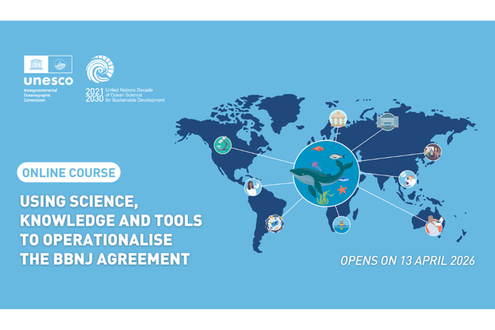
Changing Tides: The High Seas Treaty Explained
03 Apr 2023
An explainer article on the recently agreed (and soon to be adopted) High Seas Treaty, the first international agreement to protect the world's oceans aims to create “international parks” in the high seas.
news

Chemical defence mechanisms may not protect Antarctic seafloor animals and their value for drug discovery
21 Mar 2023
Long-lived sponges, intestine-like worms, colonies of sea squirts and many other cold-loving animals populate the seafloor around Antarctica. But the arrival of outsiders (non-natives) in ships’ ballast water, on plastic refuse or on floating kelp, or encouraged by warming temperatures are threatening this ecosystem. Like their northern counterparts, benthic organisms in Antarctica make chemical compounds to defend themselves from local predators. Are these defences enough to repel the increasing population of non-native invaders?